
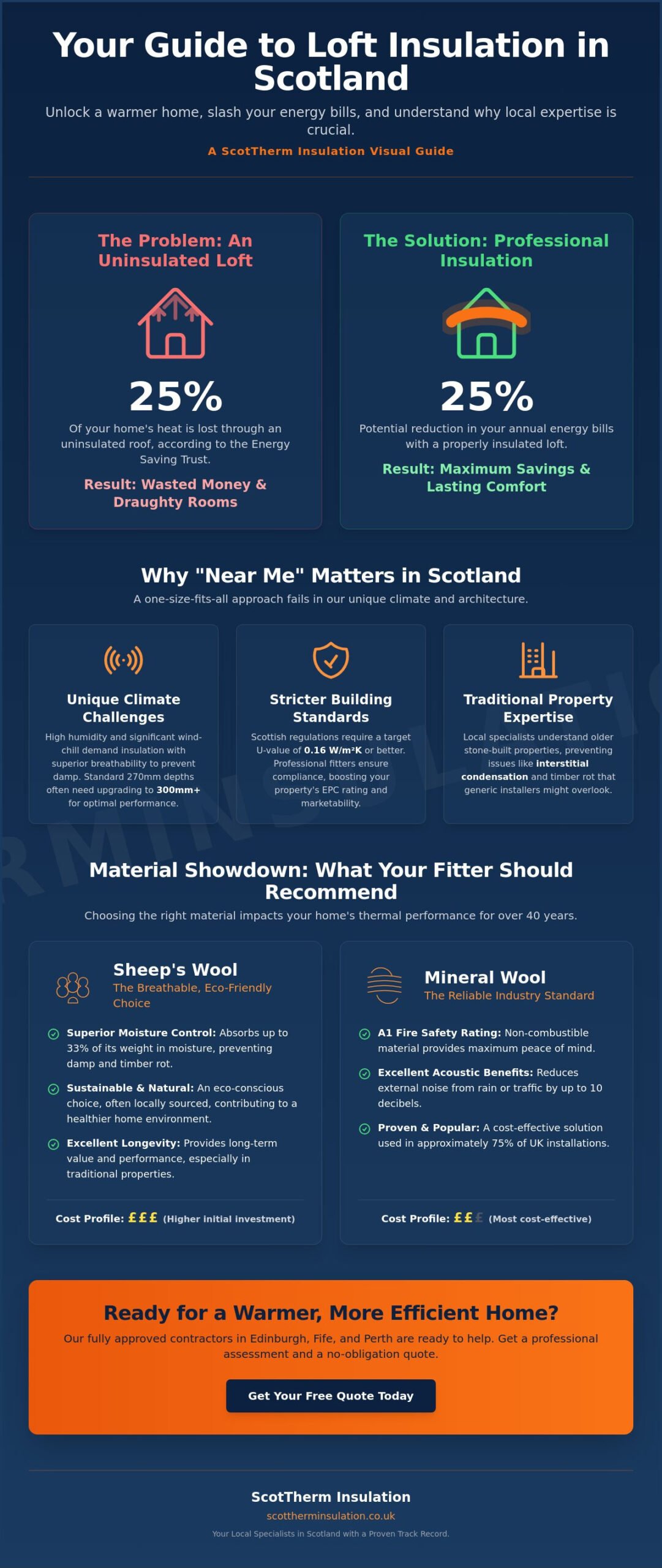
Did you know that roughly 25% of the heat you pay for in your home is currently escaping straight through your roof, according to data from the Energy Saving Trust? It’s frustrating to watch your heating bills climb every winter whilst your rooms still feel draughty and cold. Most homeowners in Scotland understand that a well-insulated home is the key to comfort, but finding reliable loft insulation fitters near me who won’t leave a mess or cut corners can feel like a daunting task. You deserve a home that stays warm without the stress of unreliable contractors or confusing technical jargon.
We’re here to help you secure a warmer home and slash your monthly energy outgoings by up to 25% through expert, professional installation. This guide highlights the most trusted specialists across Edinburgh, Fife, and Perth, ensuring you get the peace of mind that comes with fully approved contractors and a high-quality finish. We will explain how to identify the best local experts and why professional fitting is the smartest investment for your property this year.
Key Takeaways
- Discover how professional fitting tailored to the Scottish climate can slash your annual energy bills by as much as 25% whilst enhancing home comfort.
- Compare the benefits of different materials, including why eco-friendly sheep’s wool is becoming a favourite choice for homeowners in Perth and Stirling.
- Learn how to identify fully approved loft insulation fitters near me and the essential questions to ask to ensure you hire a contractor with a proven track record.
- Prepare your home for a seamless installation with our expert guide on clearing your space and understanding typical project timelines for semi-detached properties.
- Find out why local expertise in Edinburgh and Fife is vital for ensuring your insulation meets the highest standards of heat retention and long-term efficiency.
Why Finding Local Loft Insulation Fitters in Scotland Matters
Professional loft insulation fitting is the precise application of building insulation materials to create a seamless thermal envelope. When you search for loft insulation fitters near me, you aren’t just looking for someone to lay mineral wool; you’re looking for a specialist who understands how to trap heat while allowing your home to breathe. In Scotland, this balance is delicate. Poorly fitted insulation leads to thermal bridging, where heat escapes through gaps, and cold spots create breeding grounds for mould.
Generic UK installers often apply a “one size fits all” approach that doesn’t account for the unique architecture of Scottish homes. Our specialists focus on the 2023 Scottish Building Standards, which are often more rigorous than those found elsewhere. By choosing a local expert, you ensure your installation prevents interstitial condensation, a common issue in our older stone-built properties. This same level of specialist care is essential when upgrading period features; for example, the installation of heritage french doors cheshire allows homeowners to maintain a property’s historic character while benefiting from modern thermal standards. This technical proficiency is what delivers the promise of Maximum Savings & Comfort for your household.
The Impact of the Scottish Climate on Your Loft
The climate in Edinburgh and Fife presents specific challenges. Coastal areas like North Berwick experience high humidity and significant wind-chill that can strip heat from a building in minutes. Standard insulation depths of 270mm might suffice in the south, but northern exposures often require 300mm or more to maintain efficiency. Our fitters prioritise breathability. We use materials that prevent damp from settling in your rafters, ensuring your home stays dry despite the relentless Scottish rain.
Understanding Local Building Regulations
Scottish building standards are distinct. The Technical Handbook (Section 6: Energy) requires specific U-values to ensure homes remain energy efficient. A professional fitter ensures your loft meets the target of 0.16 W/m²K or better. This compliance is vital for your Energy Performance Certificate (EPC). Improving your EPC rating isn’t just about the environment; it’s a proven way to increase your property’s marketability. Our Fully Approved contractors provide the documentation you need to prove your home meets these high benchmarks.
Choosing local loft insulation fitters near me means hiring a team with a Proven Track Record in your specific postcode. We don’t guess the requirements for a Fife bungalow or an Edinburgh tenement; we know them. This regional expertise ensures that every roll of insulation and every sealed gap contributes to a warmer, more sustainable living space. It’s about long-term reliability and the peace of mind that comes from a job done right the first time.
Comparing Materials: What Your Fitter Should Recommend
Selecting the right material is a decision that impacts your home’s thermal performance for 40 years or more. Professional loft insulation fitters near me will typically suggest three main options: mineral wool, sheep’s wool, or rigid insulation boards. Each serves a different purpose based on your property’s age and construction. For those insulating older properties in Scotland, the choice often hinges on breathability and moisture control.
The Benefits of Sheep’s Wool in Damp Climates
Sheep’s wool is a breathable, high-performance alternative to synthetic fibres. It’s rapidly becoming the favourite choice for eco-conscious homeowners in Perth and Stirling because it’s sustainable and locally sourced. Natural wool can absorb up to 33% of its weight in moisture without losing its insulating properties, which is vital in the damp Scottish climate. It helps prevent timber rot in traditional joist lofts by regulating humidity levels naturally. While the initial cost is higher than glass wool, its longevity and environmental credentials provide excellent long-term value.
Mineral Wool: The Reliable Industry Standard
Mineral wool remains a popular and cost-effective choice for many Scottish homes, making up approximately 75% of UK installations. It’s favoured for its A1 non-combustible fire safety rating and impressive acoustic benefits. It can reduce external noise, such as rain or traffic, by up to 10 decibels. Installation is straightforward for standard joists, as the flexible batts can be layered to reach the 270mm depth required by current building regulations. However, it’s bulkier than rigid solutions and requires careful handling to avoid skin irritation.
Rigid PIR insulation boards are better suited for room-in-roof projects or rafters. They provide a high thermal R-value with half the thickness of wool, though they require precision cutting to avoid air gaps. Most expert loft insulation fitters will recommend a combination of materials depending on your loft’s specific layout.
- Mineral Wool: Best for standard joists; high fire safety; most budget-friendly.
- Sheep’s Wool: Best for traditional stone buildings; eco-friendly; moisture-regulating.
- Insulation Boards: Best for rafters and sloped ceilings; space-saving; higher material cost.
Choosing the correct material ensures you achieve maximum savings and comfort. A local specialist will assess your loft’s ventilation and joist spacing before recommending the most effective solution for your specific postcode. This tailored approach prevents common issues like interstitial condensation, which can occur if the wrong material is used in a traditional building.
Vetting Loft Insulation Companies Near You
Finding reliable loft insulation fitters near me is about more than a quick search; it’s about securing your home’s thermal efficiency for the next 40 years. Reputable Scottish contractors always begin with a free, no-obligation inspection. This survey allows a specialist to assess your joist spacing, current levels of mineral wool, and any signs of damp. If a company attempts to quote you over the phone without seeing your loft, they aren’t following the professional standards required to deliver maximum savings and comfort. A local company with a proven track record in the Central Belt understands how our specific climate impacts heat loss and moisture control. To compare your options thoroughly, it’s worth reviewing the top loft insulation companies in Scotland and how to choose the best installer in 2026 before committing to a contractor.
Checklist for Hiring a Professional Fitter
Professionalism in the Scottish market requires specific credentials. Ensure your chosen fitter is fully approved and carries valid public liability insurance. Look for memberships in the National Insulation Association (NIA) or TrustMark. These bodies ensure work meets the Scottish Building Regulations regarding thermal resistance and fire safety. You should also ask if they’ve worked on Edinburgh tenements or Glasgow red sandstone villas. These properties have unique architectural quirks that demand experienced hands. Finally, confirm they’ll bag and remove old, degraded insulation. Leaving 30 year old dust in your loft isn’t just messy; it’s a health hazard.
- Verify NIA or TrustMark certifications during the first visit.
- Check for a minimum 25 year guarantee on both materials and workmanship.
- Ask for a clear plan on how they’ll protect your living areas from dust.
- Ensure they’re familiar with the 270mm depth requirement for modern efficiency.
Red Flags to Watch Out For
Be cautious of high-pressure sales tactics. A trusted local specialist won’t demand an immediate deposit before a site survey is completed. Avoid “one-size-fits-all” pricing. Every loft is different. Some have narrow hatches, whilst others have complex wiring or water tanks that need lagging. If a quote doesn’t account for these variables, expect the price to climb later. Perhaps the biggest warning sign is a lack of focus on airflow. Proper insulation must work with your home’s ventilation. Installers who ignore soffit vents or tile vents risk creating condensation issues that lead to timber rot. If they don’t mention ventilation, they aren’t the right fitters for your home.
By choosing a company that prioritises a “survey-first” approach, you ensure that your investment is protected. This steady, disciplined method is what separates a “cowboy” outfit from a dedicated team of loft insulation fitters near me. Your home deserves a solution that’s been tailored to its specific structural needs, ensuring long-term peace of mind and lower energy bills.
What to Expect During Your Loft Insulation Installation
Once you’ve selected professional loft insulation fitters near me, the physical transformation of your home begins. Preparation is straightforward but essential for a smooth experience. You should clear a path from your front door to the loft hatch and remove all stored items from the attic space before the team arrives. This allows the installers to work efficiently without delays. For a typical three-bedroom semi-detached home, a professional team usually completes the installation within 2 to 4 hours. This timeline ensures minimal disruption to your daily routine whilst providing a permanent upgrade to your home’s thermal performance.
Safety is a primary focus for any “Fully Approved” contractor. Installers will arrive equipped with FFP3 respirators, protective coveralls, and gloves to manage mineral wool fibres and dust. They use professional crawling boards to move across the joists safely, which prevents any accidental damage to your ceilings. Before they leave, the team will tidy the work area and ensure all debris is removed. This emphasis on a clean and safe workspace is a hallmark of professional property services, much like the commercial maintenance provided by That’s Cleaning for businesses in the Bristol area requiring high standards of hygiene. You can verify the quality of the work by checking that the insulation is level across the entire space and that no gaps are visible between the rolls.
The Step-by-Step Fitting Process
- Layering for Performance: Fitters lay a base layer of mineral wool between the joists, followed by a thick cross-layer laid at a 90-degree angle. This technique eliminates thermal bridging and ensures the loft reaches the industry-recommended 270mm depth.
- Hatch and Pipe Protection: The team will insulate the loft hatch with foam strips and secure lagging around all water tanks and pipes. This prevents pipes from freezing and ensures heat doesn’t escape through the hatch.
- Ventilation Management: Maintaining eaves ventilation is a critical step. Fitters install vents or baffles at the roof edges to keep airflow moving, which stops condensation from rotting your roof timbers.
Maintaining Access and Storage
Many homeowners worry about losing their storage space when upgrading to thicker insulation. To solve this, fitters use loft legs or stilts. These recycled plastic supports create a raised framework that allows you to install boards above the insulation without squashing the material. Compressing loft insulation significantly reduces its thermal efficiency because it removes the air pockets required to trap heat. This raised system ensures you maintain your storage capacity whilst achieving Maximum Savings & Comfort.
For long-term access, many “Fully Approved” installers recommend fitting aluminium loft ladders. These are lightweight, durable, and provide a much safer alternative to using household stepladders. By choosing experienced loft insulation fitters near me, you ensure that every component, from the ladders to the ventilation, meets building regulations and provides a Proven Track Record of reliability.
ScotTherm Insulation: Your Local Specialists in Scotland
ScotTherm Insulation is dedicated to helping Scottish homeowners achieve maximum savings and comfort through superior thermal performance. We understand that a home is more than just a building; it’s a sanctuary that should remain warm whilst keeping energy costs manageable. Our team provides comprehensive coverage across the central belt and beyond, specifically serving Edinburgh, Fife, Perth, Stirling, and North Berwick. By maintaining a “Fully Approved” status, we offer the peace of mind that comes from knowing your project is handled by verified professionals who adhere to the highest safety benchmarks.
We pride ourselves on our versatile approach to materials. Whether your property requires the cost-effective efficiency of high-quality mineral wool or the breathable, sustainable benefits of sheep’s wool, we have the expertise to deliver. Sheep’s wool is particularly effective for older Scottish properties because it manages moisture levels naturally, preventing damp whilst providing exceptional heat retention. If you’ve been searching for reliable loft insulation fitters near me, our “Fully Approved” contractors provide the technical proficiency required for a seamless installation.
Local Knowledge, National Standards
Our team doesn’t just fit insulation; we tailor every installation to the specific needs of the local community. A Victorian tenement in Edinburgh requires a different strategy than a modern detached home in North Berwick. We’ve built a proven track record across Scotland by understanding these regional nuances. We don’t work in a vacuum either. Our collaborative approach involves working alongside the best installers in the country to ensure our methods remain at the cutting edge of the industry.
- Regional Expertise: We understand the specific weather challenges faced by homes in Fife and Perth.
- Verified Quality: Our “Fully Approved” status ensures every job meets national building regulations.
- Collaborative Network: We share best practices with top-tier professionals to maintain our high standards.
Start Your Energy Saving Journey Today
Taking the first step toward a more efficient home is straightforward. You can book a specialist free insulation inspection with our expert team to identify exactly where your property is losing heat. We don’t use high-pressure sales tactics. Instead, we provide a no-obligation assessment that looks at your current insulation levels, the condition of your roof timbers, and the adequacy of your loft ventilation.
During the survey, we’ll explain the specific benefits you can expect, from reduced carbon emissions to lower monthly outgoings. It’s a transparent process designed to give you all the facts before you commit. We’ve helped thousands of residents across Scotland transform their living spaces into energy-efficient homes. Book your free insulation survey with ScotTherm today and ensure your home stays warm for years to come.
Secure Your Home’s Maximum Savings and Comfort
Upgrading your home’s thermal envelope is one of the most effective ways to reduce energy waste. According to data from the Energy Saving Trust, installing 270mm of loft insulation can save a typical detached house in Scotland up to £445 annually on heating bills. Achieving these results requires more than just the right materials; it demands the precision of experienced professionals who understand the local climate. When you search for loft insulation fitters near me, prioritise installers who offer sustainable solutions like sheep’s wool, which provides natural breathability and exceptional heat retention. Understanding how the leading loft insulation companies in Scotland compare can help you make a fully informed decision before booking your installation.
ScotTherm Insulation stands as a team of Fully Approved Scottish Contractors with a proven track record across Edinburgh and the Central Belt. We’ve built our reputation on technical proficiency and a commitment to domestic well-being. By choosing specialists in sustainable sheep’s wool, you ensure your property remains protected against the damp Scottish winters whilst significantly lowering your carbon footprint. It’s time to stop letting heat escape through your roof and start investing in long-term reliability.
Get a Free Specialist Insulation Inspection from ScotTherm
Take the first step toward a cosier, more cost-effective home today.
Frequently Asked Questions
How much does it cost to have loft insulation fitted by a professional?
Professional loft insulation costs typically range between £880 for a semi-detached house and £1,100 for a detached property according to 2024 Energy Saving Trust data. These figures cover both materials and labour for a standard mineral wool installation. Your final quote depends on the loft size and the levels of material already present in your home.
Can I get a grant for loft insulation in Scotland in 2026?
You can access grants in Scotland through the ECO4 scheme which is scheduled to run until 31 March 2026. This UK government initiative provides funding for energy efficiency measures to eligible households. You may also find support through Home Energy Scotland, which offers interest-free loans and grants for Scottish homeowners looking to reduce carbon emissions and energy waste. Edinburgh homeowners in particular can explore the full range of available funding options by reviewing the loft insulation grants Edinburgh residents can access in 2026, including ECO4, GBIS, and Warmer Homes Scotland eligibility criteria.
Is it worth paying a professional fitter or should I do it myself?
Paying a professional fitter is generally the better option because it ensures you achieve a seamless thermal envelope without creating dangerous cold spots. Fully approved contractors understand how to navigate electrical cables and provide essential ventilation that prevents damp. While DIY might save on initial labour, professional installation often pays for itself through 25% lower energy bills and guaranteed workmanship.
How long does professional loft insulation last?
Professional loft insulation is designed to last for at least 40 years without losing its thermal efficiency. High-quality mineral wool and glass wool products are durable and don’t degrade if they’re kept dry and uncompressed. This long lifespan ensures maximum savings and comfort for the duration of your residency in the property whilst maintaining the building’s EPC rating.
Will loft insulation make my house feel warmer immediately?
You’ll notice your house feels warmer immediately after installation because loft insulation stops up to 25% of your home’s heat from escaping through the roof. The temperature in upstairs rooms becomes more stable; your boiler won’t need to work as hard to maintain a comfortable environment. This creates an instant improvement in domestic well-being and reduces heat-up times for the entire building.
Do loft insulation fitters near me also remove old insulation?
Most professional loft insulation fitters near me offer a full removal and disposal service for old, damp, or contaminated materials. They use industrial vacuums or sealed bags to ensure that dust and debris don’t enter your living spaces during the process. Clearing the space allows for a clean, effective installation of modern materials that meet current 270mm depth standards.
What is the recommended depth for loft insulation in the UK?
The current recommended depth for loft insulation in the UK is 270mm for glass wool or mineral wool products. Building regulations have increased this requirement from older standards to ensure maximum energy efficiency. If your loft only has 100mm of old material, a professional fitter will top it up with an additional 170mm to reach the required 270mm target.
Can I still use my loft for storage after it has been insulated?
You can still use your loft for storage if you install a raised boarding system such as loft legs. It’s vital that you don’t place items directly onto the insulation, as compressing the material reduces its thermal effectiveness by over 50%. Using loft legs creates a sturdy platform above the 270mm insulation layer, preserving the air gap and your home’s warmth.