
Could the very insulation meant to keep your Stirling home warm actually be the silent cause of damp in your roof space? For many homeowners in our damp, cold climate, the fear of condensation is just as pressing as the sting of rising heating bills. It’s frustrating to receive conflicting advice on which materials are safe for older roofs, especially when you simply want a warmer home and lower monthly outgoings. As dedicated attic insulation specialists in Stirling, we know that effective thermal performance is about more than just thickness; it’s about matching material breathability to your property’s specific architectural heritage.
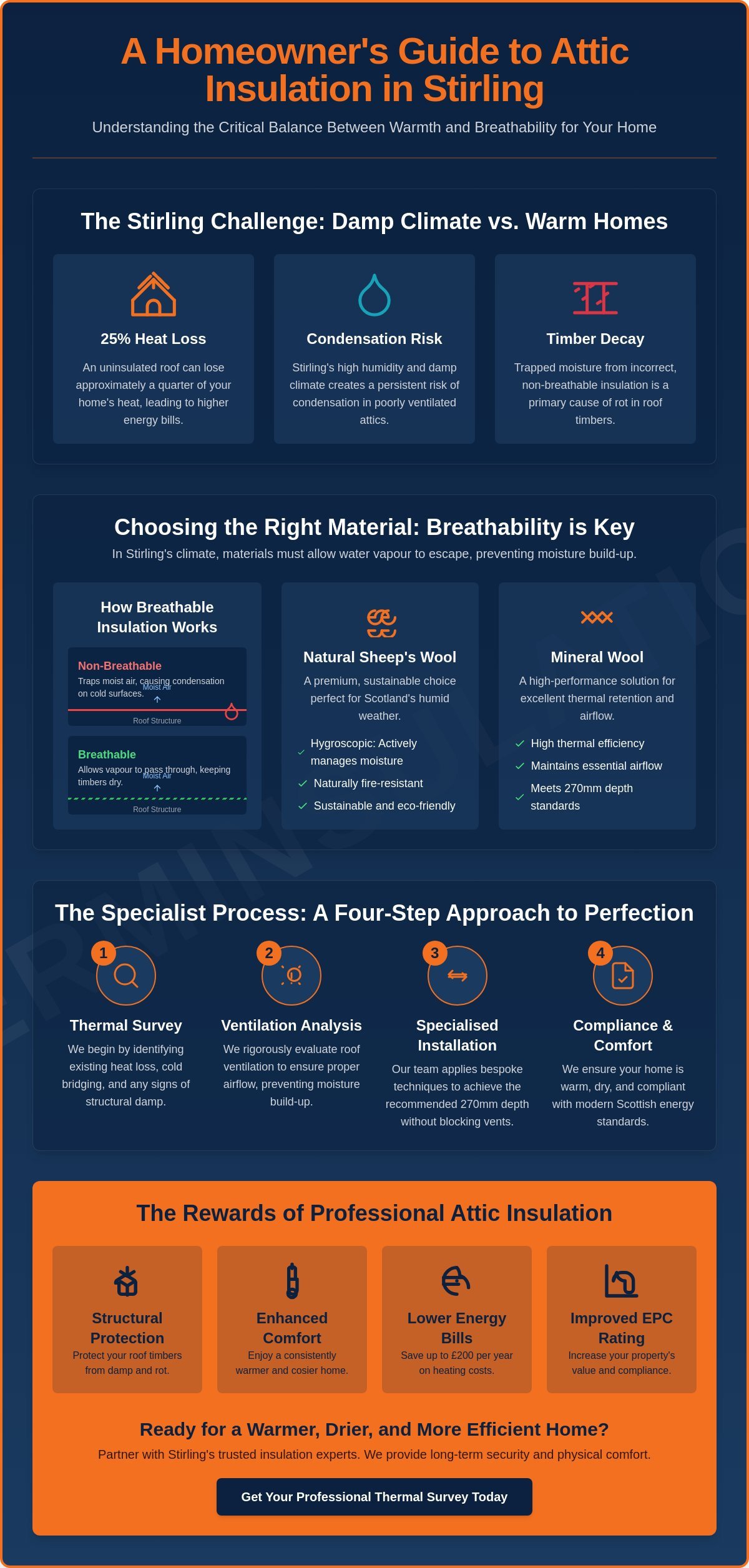
An uninsulated home can lose approximately 25% of its heat through the roof, yet rushing into the wrong solution can lead to trapped moisture and timber decay. We’re here to help you navigate these choices with confidence. You’ll discover how premium materials like sheep’s wool and mineral wool can reduce your energy costs by up to £200 a year whilst ensuring your roof remains perfectly breathable. We will examine the current 270mm depth standards and the specialist installation techniques that provide long-term security and physical comfort for your Stirling property.
Key Takeaways
- Find out why attic insulation specialists stirling based professionals evaluate roof ventilation as much as insulation to prevent damp and condensation.
- Compare the benefits of premium, breathable materials like sheep’s wool and mineral wool to find the best thermal fit for Stirling’s specific climate.
- Learn how to resolve the “cold sloping ceiling” issue in traditional Scottish homes using specialised room-in-roof insulation techniques.
- Explore the specialist installation process, including the importance of a thermal survey to identify existing heat loss and structural damp.
- Identify how professional installation ensures your roof remains breathable whilst delivering long-term financial efficiency and domestic comfort.
Why Stirling Homeowners Require Attic Insulation Specialists
Living in Stirling means facing a unique set of environmental challenges. Our local climate is defined by high humidity and consistent wind-driven rain, which places immense pressure on a property’s thermal envelope. Many residents find that standard DIY approaches or general building work simply don’t account for these regional factors. A true specialist is defined by their ability to evaluate ventilation as rigorously as thermal retention. Without this balance, your attic becomes a trap for moisture rather than a barrier against the cold.
Professional attic insulation specialists in Stirling understand that every roof space is a living system. When we install high-performance solutions like mineral wool or sheep’s wool insulation, we’re not just layering material; we’re managing airflow. This technical precision ensures that your home reaches the current recommended depth of 270mm whilst maintaining the necessary breathability to protect your roof timbers from rot. Understanding the science behind building insulation materials is essential for long-term property health in the Central Belt.
Stirling’s Varied Housing Stock and Insulation Needs
Stirling’s architectural heritage is diverse, ranging from traditional Victorian villas and stone tenements to modern timber-frame developments. Each requires a bespoke approach. Older properties often feature complex rooflines with dormer windows and eaves that are prone to “cold bridging.” This occurs when heat escapes through structural elements that bypass the insulation layer. General contractors frequently overlook these gaps, leaving cold spots that lead to localised damp. We focus on identifying these thermal weak points to ensure a continuous, effective barrier that meets modern Scottish energy standards.
The Dangers of Non-Specialist Installation
The risks of poor installation are often invisible until the damage is done. If insulation is packed too tightly into the eaves, it blocks the soffit vents and prevents air circulation. This mistake is the primary cause of interstitial condensation, where water vapour turns into liquid on the underside of your roof felt. Beyond the structural risks, there’s a clear financial imperative to get it right. With Scottish energy efficiency standards tightening towards 2026, properties with poor EPC ratings face higher running costs and potential regulatory hurdles. Investing in expert verification ensures your home remains warm, dry, and compliant with evolving national requirements.
Selecting the Right Materials for Stirling’s Climate
Choosing the correct insulation involves more than just picking the thickest roll available. In the damp Stirlingshire climate, the science of breathability is the most critical factor in protecting your property. As attic insulation specialists in Stirling, we prioritise materials that manage moisture whilst maintaining high thermal resistance. We evaluate every product based on its thermal conductivity, commonly known as the “lambda value.” A lower lambda value indicates that a material is more efficient at preventing heat from escaping your home. Understanding these technical specifications ensures your home remains warm without risking the structural integrity of the roof.
According to the Energy Saving Trust guide, proper material selection is a cornerstone of reducing domestic energy consumption. For many residents in the Central Belt, the decision rests on a balance between cost, performance, and environmental impact. Whilst rigid PIR boards are often used in tight spaces due to their high thermal efficiency, they lack the breathability required for many older, stone-built Stirling homes. This is why we often recommend fibrous materials that allow water vapour to pass through, preventing the build-up of interstitial condensation.
Natural Sheep’s Wool: The Breathable Scottish Choice
Natural sheep’s wool is becoming the favourite for local eco-conscious owners. It is a hygroscopic material, which means it can absorb and release moisture without losing its insulating properties. This unique characteristic is perfect for Stirling’s humid weather, as it helps regulate the humidity levels within your attic space. It is a sustainable, premium option that offers both physical comfort and the security of knowing your home is protected by a naturally fire-resistant material. If you are looking to upgrade your home’s efficiency, you can explore our range of breathable insulation options to find the best fit for your property.
High-Performance Mineral Wool and its Applications
Mineral wool remains a highly effective and popular choice for many attic applications. It is made from molten glass or stone spun into a fibre, providing excellent fire resistance and acoustic dampening. This material is particularly useful for achieving the recommended 270mm depth in standard lofts. It fits snugly between joists, eliminating gaps that lead to heat loss. Because it is versatile and cost-effective, mineral wool is often the primary choice for homeowners seeking a significant reduction in their energy bills whilst adhering to the latest building standards. Our team ensures that every installation maintains the necessary airflow at the eaves, keeping your attic dry and your living space warm.
Specialised Attic Services: Beyond Simple Loft Insulation
Many Stirling properties feature traditional 1.5-storey designs where a standard roll of insulation on the loft floor is simply insufficient. As dedicated attic insulation specialists in Stirling, we look beyond the horizontal surfaces to identify every point of heat escape. This comprehensive approach is vital for maintaining a continuous thermal envelope, especially in homes with complex rooflines or converted living spaces. Failing to address sloping ceilings or eaves creates thermal gaps that undermine the efficiency of the entire system and lead to those familiar draughts.
According to the Energy Saving Trust guide to loft insulation, ensuring a complete seal is essential for maximum energy savings. We often find that the loft hatch is the most neglected component in the attic. An uninsulated hatch acts like a chimney, drawing warm air out of your living rooms and into the cold roof space. We resolve this by fitting draught-proof seals and insulating the hatch itself, ensuring your attic ladder doesn’t become a bridge for the cold. This attention to detail is what distinguishes attic insulation specialists in Stirling from general contractors.
Room in Roof Insulation: A Stirling Speciality
Sloping ceilings in attic rooms are notorious for being the coldest part of a house. Standard building practices in the past often left these areas with little to no protection. Our specialised room-in-roof insulation services target these “cold slopes” using high-performance materials that fit within the rafter depth. This transformation turns a chilly, underused room into a comfortable, year-round living space. By treating the “dead spaces” behind knee walls, we create a seamless barrier that stops heat from escaping into the eaves.
Loft Boarding and Storage Solutions Without Compressing Insulation
Many homeowners want to use their attic for storage, but traditional boarding often involves squashing the insulation. Compressing mineral wool or sheep’s wool significantly reduces its ability to trap heat; it destroys the air pockets that provide the thermal barrier. To maintain the recommended 270mm depth, we utilise raised loft boarding systems. These create a sturdy platform above the insulation layer, allowing for ample storage whilst preserving the thermal performance of your home. We also offer underfloor insulation for attic conversions, which helps regulate temperatures between floors and provides an extra layer of acoustic dampening for a quieter, more peaceful home environment.
The Specialist Installation Process: What to Expect
A true specialist installation begins long before the first roll of insulation arrives. As leading attic insulation specialists in Stirling, we follow a rigorous, step-by-step protocol to ensure your home’s thermal performance is maximised whilst ensuring structural safety. This process bridges the gap between basic building work and high-performance environmental engineering. By following a structured approach, we provide homeowners with the peace of mind that their investment is both technically sound and financially efficient.
Step 1: The Comprehensive Attic Survey
Our team begins by assessing your attic’s current state. We don’t just measure the floor; we look for signs of historical damp, active leaks, or structural issues in the timber. This survey identifies existing insulation levels and determines if they need to be topped up or replaced to meet the current 270mm depth standard. We also examine electrical wiring and recessed lighting to ensure all heat-generating components are safely protected before any material is laid. This initial verification is essential for avoiding the “fear of damp” that often accompanies poor-quality installations.
Step 2: Professional Fitting and Draught Proofing
Once the survey is complete, our technicians prepare the work area to protect your living space. We use drop sheets and specialised equipment to ensure a clean, efficient process. The installation involves precision cutting of your chosen material, such as mineral wool or sheep’s wool, to eliminate all gaps and thermal bridges. We pay particular attention to the eaves and the loft hatch, as these are the most common areas for heat loss. Book your professional thermal survey today to identify exactly where your home is losing energy and how we can secure it.
Step 3: Certification and Quality Assurance
The final stage of our process is the most critical for long-term property health. We verify that the attic’s cross-flow ventilation remains unobstructed at the soffits. This prevents the build-up of interstitial moisture that leads to timber rot and mould. We provide a clear record of the work performed, confirming that your home now meets or exceeds current energy efficiency standards. This verification acts as a badge of quality for your property, ensuring long-term value and immediate physical comfort for your family. Our disciplined approach ensures that every promise of a warmer home is backed by professional standards.
Partnering with ScotTherm Insulation: Stirling’s Trusted Insulation Experts
Choosing the right partner for your home’s thermal upgrade is a decision that impacts both your bank balance and your daily comfort. At ScotTherm Insulation, we don’t just provide a service; we act as dedicated attic insulation specialists in Stirling who understand the specific needs of our regional community. We’ve built our reputation on a foundation of technical proficiency and local accountability. By focusing on the intersection of financial efficiency and physical ease, we ensure that every project we undertake delivers long-term value for homeowners across Stirling, Perth, and the wider Central Belt.
Our team takes immense pride in the tangible impact of our work on the local environment. We know that a warmer home is a happier one, and we’re committed to helping our neighbours achieve that without the stress of confusing technical jargon or high-pressure sales. We position ourselves as both a primary service expert and a collaborative industry leader. This means we bring a disciplined, quality-conscious approach to every attic, whether we’re working on a modern timber-frame house or a traditional stone-built property. We’re here to ensure your roof remains a protective barrier against the elements, not a source of worry or unexpected maintenance costs.
Regional Expertise You Can Rely On
Stirling’s geography presents specific challenges that a national, one-size-fits-all contractor might miss. Our deep understanding of local weather patterns, particularly the high humidity and wind-driven rain common in Stirlingshire, informs every material choice we make. ScotTherm Insulation specialises in both modern and traditional Scottish building methods. This expertise allows us to navigate the complexities of older rooflines, ensuring that insulation is installed without compromising the essential breathability of the structure. We don’t just lay material; we protect the architectural heritage of our region whilst preparing it for a more energy-efficient future. Our local presence ensures we remain accountable to the community we serve.
Our Technical Standards and Certifications
We prioritise high-performance, breathable materials like sheep’s wool and mineral wool because they offer the best protection for Scottish homes. These premium options align with our commitment to environmental responsibility and long-term home health. The ScotTherm Insulation installation process follows a highly structured, logical pattern that identifies specific thermal weak points and resolves them with precision. We maintain rigorous technical standards to ensure that every installation meets current energy efficiency requirements. This professional history and adherence to industry-standard terminology act as a guarantee of safety and reliability for our clients. We operate as a dedicated, results-oriented team that takes pride in the precision required by the technical installation industry.
Securing your home’s thermal performance starts with an expert evaluation of your current attic space. We invite you to take the first step towards a warmer, more cost-effective home by arranging a specialist insulation inspection. Our team will provide a clear, authoritative assessment of your property’s needs, helping you move from uncertainty to the peace of mind that comes from a professionally verified home. Let us help you transform your comfort and reduce your outgoings with a solution tailored to your specific Stirling property.
Secure Your Home’s Future with Expert Thermal Performance
Optimising your home’s efficiency is a vital step in managing long-term costs whilst enhancing your domestic well-being. By choosing high-performance, breathable materials, you’ve seen how it’s possible to protect your property’s structural integrity against Stirling’s damp climate. The transition from a cold, draughty roof space to a thermally secure environment involves more than just adding bulk; it requires the technical precision that only attic insulation specialists in Stirling can provide. This investment ensures your home remains warm, dry, and compliant with evolving standards for decades to come.
ScotTherm Insulation remains dedicated to providing the regional expertise and certified reliability that Stirling homeowners deserve. Our focus on breathable sheep’s wool and professional room-in-roof solutions ensures that your property’s heritage is respected whilst its performance is transformed. By addressing every thermal bridge and ensuring continuous ventilation, we deliver the peace of mind that comes from a job done right. Don’t leave your comfort to chance when a warmer, more cost-effective home is within reach.
Book your specialist free insulation inspection in Stirling today and let us help you secure your property’s thermal future. Our team at ScotTherm Insulation is ready to provide the authoritative assessment and quality installation your home requires.
Frequently Asked Questions
Do I need to remove my old attic insulation before specialists install new layers?
Old insulation doesn’t always need removal before we begin work. If your existing material is dry and free from pests, our attic insulation specialists in Stirling can simply lay new mineral wool or sheep’s wool over the top to reach the required 270mm depth. However, if the old material is damp, mouldy, or severely compressed, we recommend removal. This prevents moisture from being trapped against your ceiling timbers and ensures the new installation performs at its peak efficiency.
How long does it typically take for attic insulation to pay for itself in Stirling?
Insulation is a long-term financial investment that typically pays for itself within a few years. Adding the recommended 270mm of loft insulation can save a typical semi-detached household between £150 and £200 per year on heating bills according to industry data. Since the materials last for around 40 years with no maintenance, the cumulative savings far outweigh the initial investment. You’ll notice the physical comfort immediately, whilst the financial benefits grow every month.
Will insulating my attic lead to damp or condensation problems in my roof?
Proper installation prevents damp rather than causing it. Condensation only occurs if the insulation blocks the essential airflow at the eaves or soffits. Our specialists prioritise cross-flow ventilation and use breathable materials to ensure that water vapour can escape the roof space. This technical precision keeps your roof timbers dry and healthy throughout Stirling’s humid winters, protecting your home from the risks of interstitial condensation and timber rot.
What is the recommended depth of loft insulation for Scottish homes in 2026?
The current recommended depth for loft insulation in the UK is 270mm. This standard is required to meet the energy efficiency targets set by Part L of the Building Regulations. Our attic insulation specialists in Stirling verify that your home achieves this depth to ensure a maximum U-value of 0.16 W/m²K for retrofitted roofs. Meeting these standards is essential for achieving a better EPC rating and reducing your home’s carbon footprint.
Can I still use my attic for storage after a specialist has insulated it?
You can still use your attic for storage if you use a raised boarding system. Laying boards directly onto the insulation compresses the fibres and destroys the air pockets that trap heat, significantly reducing thermal performance. We recommend installing specialised loft legs that create a sturdy platform above the 270mm insulation layer. This allows for ample storage whilst preserving the energy-saving benefits and ensuring your insulation remains effective for its full 40-year lifespan.
Are there any grants available for attic insulation in Stirling for 2026?
Several funding options remain active in 2026 for Stirling residents. Whilst the Great British Insulation Scheme ended in March 2026, the ECO4 scheme is scheduled to run until December 2026 for those on qualifying benefits. Additionally, the Warmer Homes Scotland grant provides support for households with an income of £36,000 or less. For those who don’t qualify for grants, Home Energy Scotland offers interest-free loans to help spread the cost of energy efficiency improvements.
Why is sheep’s wool considered better than fibreglass for older Stirling properties?
Sheep’s wool is a superior choice for older Stirling properties because it is naturally hygroscopic. It can absorb and release moisture without losing its insulating properties, which helps regulate humidity in stone-built homes. Unlike fibreglass, which can trap moisture against structural elements, sheep’s wool supports the natural breathability of traditional Scottish architecture. It is also a sustainable, fire-resistant material that provides excellent acoustic dampening for a quieter, more peaceful home environment.
What is a ‘Room in Roof’ and how does its insulation differ from a standard loft?
A “Room in Roof” refers to a converted attic space or a 1.5-storey home where the ceilings follow the slope of the roof. Standard loft insulation only covers the flat floor, but room-in-roof insulation targets the sloping ceilings and the “dead spaces” behind knee walls. This creates a continuous thermal barrier for living areas that would otherwise remain cold and draughty. It requires specialised techniques to ensure the insulation fits snugly within the rafter depth without blocking essential ventilation.